smOOPs in Cancer: A Hypothetical Link Between Condensation-Prone RNAs and Oncogenesis
smOOPs in Cancer
DOI:
https://doi.org/10.54393/pbmj.v9i6.1367Abstract
A key regulator of cellular function is a condensate that is developed in the liquid-liquid phase separation (LLPS) process, including RNAs. A newly identified class of condensation-prone RNAs is termed smOOPs (semi-extractable and orthogonal organic phase separation-enriched RNAs). Recently proposed by Klobučar et al. smOOPs represent an emerging and not yet fully characterized class of condensation-prone RNAs [1]. RNA plays essential roles in a wide range of cellular processes. This editorial discusses the characteristics of smOOPs, their role in cellular metabolism, as well as in early developmental stages. Besides, dysregulation of biomolecular condensation involving condensation-prone RNAs such as smOOPs may contribute to future studies of oncogenic processes. Although direct evidence linking smOOPs to cancer is currently lacking, the discovery of smOOPs provides a useful framework for investigating whether dysregulated condensation-prone RNAs may contribute to oncogenic processes.
One of the unique characteristics of smOOPs is their long transcript, folding internal structure, and special protein binding. It exhibits a high propensity for intermolecular interactions and tend to develop condensates. Protein binding in conventional RNA is low to moderate, while smOOPs are heavily bound by RNA-binding proteins. smOOP RNAs tend to exhibit more stable or highly structured conformations compared to many conventional mRNAs that have relatively flexible structures. Typically, smOOPs are rich in hairpin loops and bulges and very tight internal loops. In addition, smOOPs usually have complex secondary structures, bind many RNA-binding proteins (RBP), are located near chromatin, and develop an intermolecular network. There are differences between conventional RNA and smOOPs; while conventional RNA is easily extracted, smOOP RNA is not [1, 2].
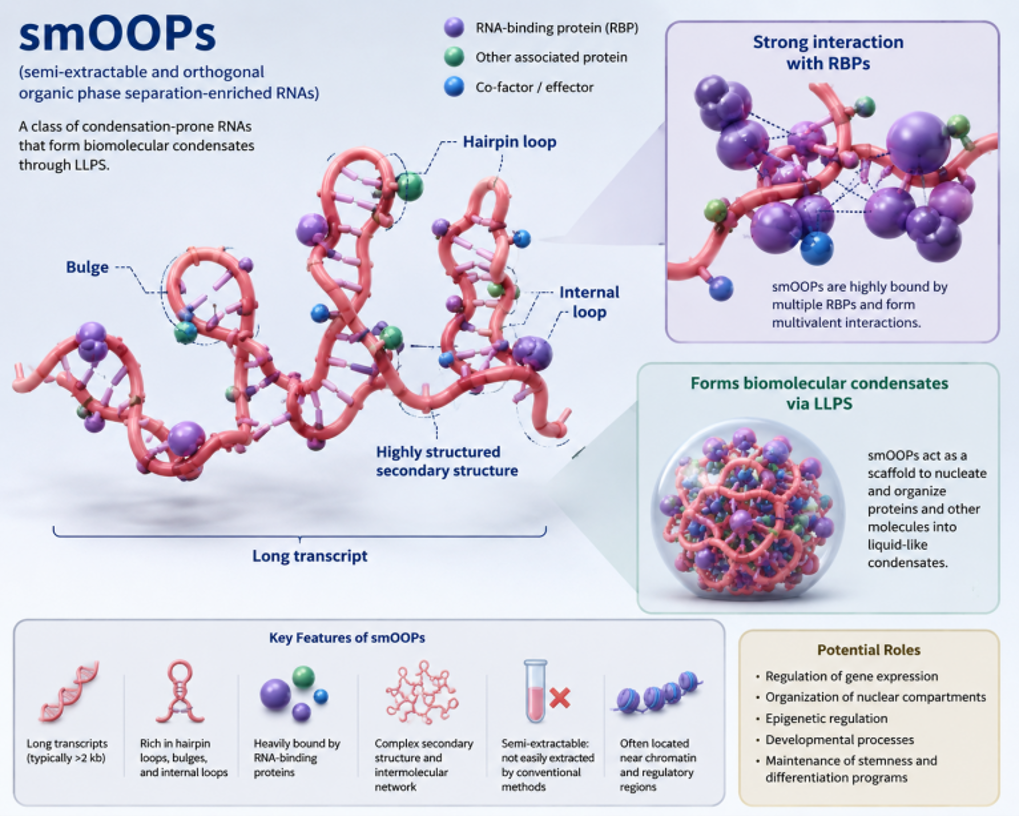
Figure 1: The Structure of smOOPs
The RNA molecule is a scaffold during the early embryonic phase. For example, smOOPs can control gene expression, epigenetic, and mediate the development of the nuclear compartment. During embryonic development, smOOPs regulate the distribution of regulatory molecules. By keeping or releasing certain signal molecules in its condensate, smOOPs may take part in the regulation of molecular environments associated with differentiation and stemness [1].
Although direct evidence linking smOOPs to cancer is still lacking, the discovery of smOOPs provides a conceptual framework to investigate how aberrant condensation might contribute to oncogenesis. Dysregulation of biomolecular condensates has been strongly associated with various malignancies, including genomic instability, epigenetic rewiring, and aberrant oncogenic signaling [3, 4]. The recent discovery of smOOPs—a class of condensation-prone RNAs that act as scaffolds for phase separation raises the possibility that aberrant smOOP function may contribute to the pathological condensates observed in cancer [1].
Aberrant smOOP-mediated condensate formation may alter the spatial organization of oncogenic regulators, potentially leading to dysregulated gene expression, chromatin remodeling, and oncogenic signaling pathways. Several cancers have been associated with aberrant biomolecular condensates and altered RNA–protein interactions, suggesting a possible future role for smOOPs-related mechanisms in oncogenesis. Those changes include not only changes in condensation that activate oncogenes and changes in proliferation control. However, current results that connect smOOPs directly to oncogenesis are still early, while most available studies of smOOPs focus on developmental biology and condensate formation.
References
Klobučar T, Novljan J, Iosub IA, Kokot B, Urbančič I, Jones DM et al. Integrative Profiling of Condensation-Prone RNAs During Early Development. Cell Genomics. 2026 Feb; 6(2). doi: 10.1016/j.xgen.2025.101065. DOI: https://doi.org/10.1016/j.xgen.2025.101065
Villanueva E, Smith T, Queiroz RM, Monti M, Pizzinga M, Elzek M et al. Efficient Recovery of the RNA-Bound Proteome and Protein-Bound Transcriptome Using Phase Separation (OOPS). Nature Protocols. 2020 Jul: 1-21. doi: 10.1038/s41596-020-0344-2. DOI: https://doi.org/10.1038/s41596-020-0344-2
Jiang L and Kang Y. Biomolecular Condensates: A New Lens on Cancer Biology. Biochimica et Biophysica Acta (BBA)-Reviews on Cancer. 2025 Feb; 1880(1): 189245. doi: 10.1016/j.bbcan.2024.189245. DOI: https://doi.org/10.1016/j.bbcan.2024.189245
Li W and Jiang H. Analysis of Phase-Separated Biomolecular Condensates in Cancer. In Cancer Systems and Integrative Biology. 2023 May: 345-356. doi: 10.1007/978-1-0716-3163-8_23. DOI: https://doi.org/10.1007/978-1-0716-3163-8_23
Downloads
Published

How to Cite
Issue
Section
License
Copyright (c) 2026 Pakistan BioMedical Journal

This work is licensed under a Creative Commons Attribution 4.0 International License.
Copyright © 2026. The Authors. Published by CrossLinks International Publishers LLC, USA. This work is licensed under a Creative Commons Attribution 4.0 International (CC BY 4.0), Copyright of each article remains with its authors, which permits unrestricted use, distribution, and reproduction in any medium, provided the original author and source are credited. For comments editor@pakistanbmj.com